

A Yearning
by Mariam Mushtaha

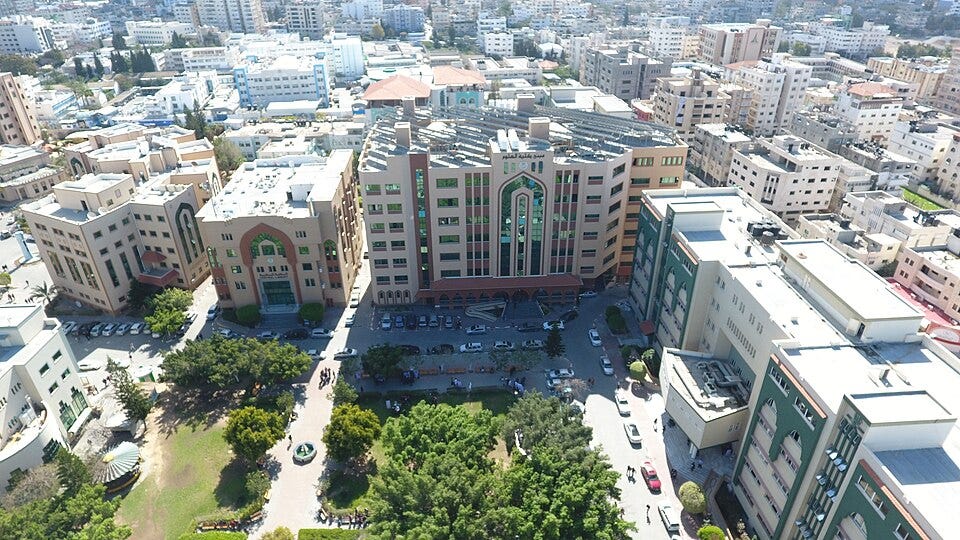
Photo: Islamic University of Gaza. “The science and library buildings.” Courtesy of Wikimedia Commons, 2018.

Each time I see another student from Gaza manage to leave to pursue their studies, I feel depressed. This is not jealousy. It is the pain of my multiple failed attempts to secure a scholarship and fulfill my dream of a real education, as they are doing.
I graduated from secondary school, Tawjihi, as we call it, in 2023 with a GPA of 99.4%. My high GPA opened up several opportunities for me to pursue my studies abroad. However, at the time, I thought I was still too young and inexperienced to live alone in another part of the world. I was deeply attached to my family. Now, I regret that decision. I wish I had been encouraged to take that bold step into the unknown. Is it too late for me?
I am currently a third year student at Islamic University of Gaza. I had only spent one month at university before the U.S.-Israel genocide began on October 7. Our education was suspended for almost nine months until the university announced the resumption of classes through an online learning system.
Online learning is challenging. To study behind screens, I walk long distances just to access the internet and electricity. But I persisted, resuming my education while at the same time applying for every scholarship I could find. The process was filled with endless barriers. Every scholarship application requires a stable internet connection, a smartphone or laptop, and official documents such as an ID, birth certificate, and sometimes a passport.
On the night of October 18th 2023, the Israeli Occupation Forces called my family’s house and told us we had five minutes to flee before they destroyed our home. That time was not enough to take anything with us, including money and important documents. The building collapsed before our eyes, along with everything inside. It took a long time to replace the documents we had lost. Not having an ID deprived me of applying for many scholarships that could have changed my life.
One day, a friend informed me about a scholarship whose deadline was that very same day.
I rushed to prepare everything I might need. Suddenly, the internet was cut off. It had already been unstable, but at least I had been able to open the scholarship page, so it had not seemed like a major problem until the connection disappeared completely.
I thought it would return within a few minutes. I waited for one hour, then two, then three, yet it never came back. The clock reached 12:00, and the deadline passed.
My friend called to ask whether I had managed to submit the application. Furious and overwhelmed, I told her that I would never apply for any scholarship again and that I was exhausted by the endless obstacles that impeded me.
I continued applying despite all the disappointment, not because I was a determined person who never gave up, but because I was tired of everything around me, especially the learning system we were forced to adapt to.
Most scholarships require an English language proficiency test, especially IELTS or TOEFL, both of which have become unavailable in Gaza. The centers that once offered these tests and provided preparatory courses have either been destroyed or forced to shut down and leave Gaza due to the constant bombardment and threats.
There is now an alternative test, the Duolingo English Test. However, it requires a quiet space, a stable internet connection, and proper preparation and practicing, which are extremely difficult to secure all at once in Gaza. In addition, not all universities or scholarships accept this particular test.
Last year, I applied for an Irish scholarship, and my application was conditionally accepted. To complete it, I had to take the Duolingo English Test. At that time, in December 2025, we were displaced to a tent in the Al-Mawasi area. I could not even find a quiet place to practice. When I began the test, I lost concentration because of the noise around me, and I was unable to complete it.
The university informed me that they would not be able to consider my application because the English language test was mandatory. Just like that, I lost another opportunity.
Since the genocide began, I have applied for two Turkish scholarships. I was accepted into one program, but because Turkey did not arrange evacuation efforts for the selected students, I lost yet another chance to pursue my education abroad.
These obstacles stand in the way of thousands of students whose only dream is to study under normal learning conditions, then return stronger and well-educated to support their homeland. We are deeply aware of the power of education in the journey toward freedom.
Yet many students are still prevented from leaving Gaza, even though depopulating the Strip has long been part of Israel’s plan. The reason, I believe, is that Israel understands the power of education and its influence on minds and societies. Hence its systematic destruction of our educational institutions.
Still, I continue to apply, with a hope that one day no barriers will define the limits of my education. I continue to reach for my future as a person who truly believes that knowledge is more powerful than any weapon.
MARIAM MUSHTAHA is a Gaza-based writer and an English language student. Her work has appeared in We Are Not Numbers, Al Jazeera English, Prism Report, The New Humanitarian, Markaz Review, The Progressive, and the Palestine Chronicle.
I just unsubscribed by mistake (because I get too many things I never get time to read), then read your writing and want to resubcribe! My friend Hassan, also in Gaza, is in a similar position. There's no justification for the horrors the people of Palestine are being put through, or for any aspect of the Nakba since the beginning.